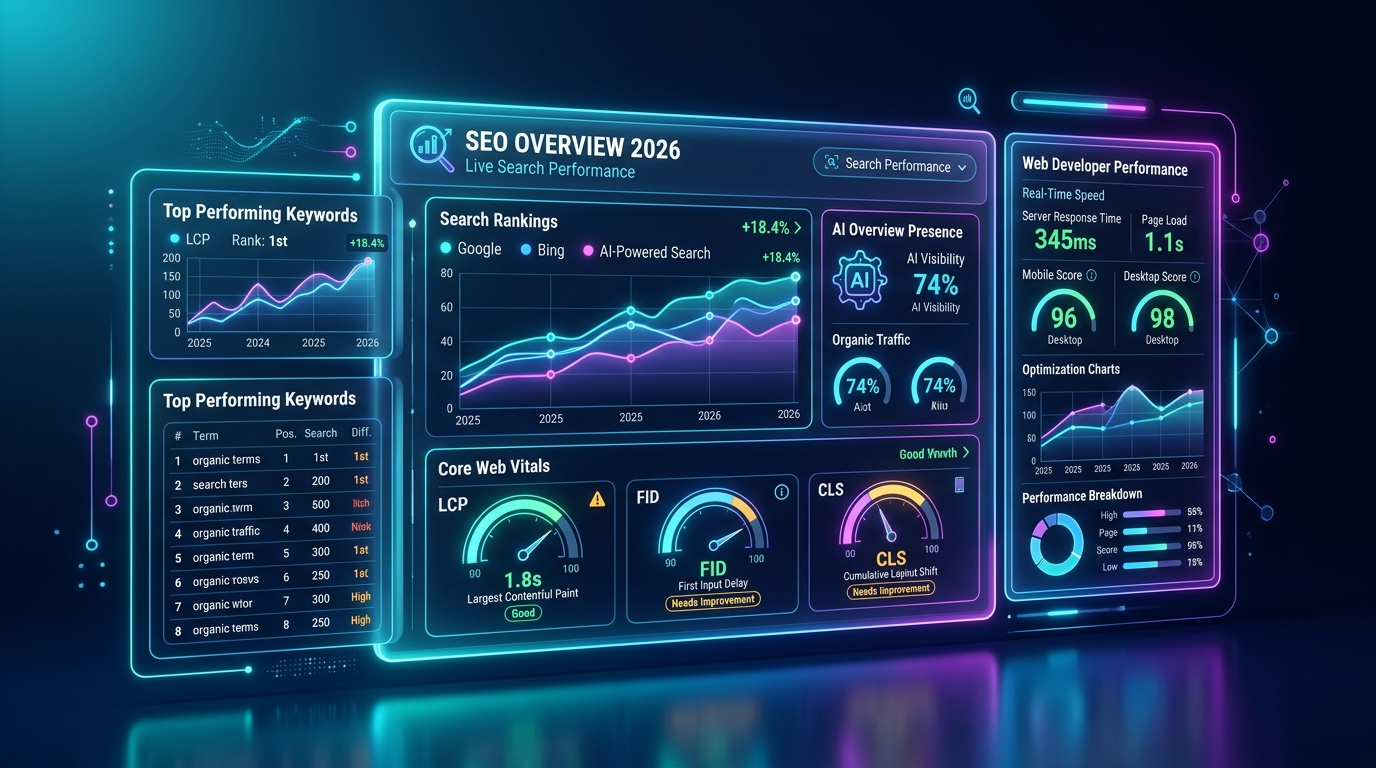

Search Engine Optimization in 2026 is driven by technical precision, user engagement metrics, and verified domain authority. Search crawlers prioritize platforms that render quickly over modern mobile networks, maintain zero layout shift, and present well-structured semantic data.
At JinStudio, our engineering team manages client-side web applications, developer utility tools, and content architectures. In this guide guide, we share our exact technical SEO audit checklist, Core Web Vitals targets, and schema implementation code snippets.
Starting from scratch? Read our foundational guide on SEO Basics for Beginners and learn how to optimize your content strategy with our Content Marketing Guide.
Pillar 1: Core Web Vitals & Technical Speed Benchmarks
Google evaluates site performance through three primary metrics: Interaction to Next Paint (INP), Largest Contentful Paint (LCP), and Cumulative Layout Shift (CLS).
| Core Web Vital | Target Threshold (2026) | Optimization Strategy |
|---|---|---|
| INP (Interaction to Next Paint) | < 200 ms | Break up long JavaScript tasks and defer non-critical scripts |
| LCP (Largest Contentful Paint) | < 1.5 sec | Preload hero images and serve assets via HTTP/2 Gzip compression |
| CLS (Cumulative Layout Shift) | 0.00 | Declare explicit width/height on images and reserve ad containers |
Pillar 2: JSON-LD Schema Structured Data Code Example
Including structured Schema markup allows search engines to feature your page in rich snippet cards. Below is an exact production JSON-LD script for technical blog posts:
{
"@context": "https://schema.org",
"@type": "BlogPosting",
"headline": "Advanced SEO Best Practices for 2026",
"author": { "@type": "Organization", "name": "JinStudio Engineering Team" },
"publisher": { "@type": "Organization", "name": "JinStudio" },
"datePublished": "2026-08-03",
"mainEntityOfPage": "https://jinstudio.net/blog/seo-best-practices-2026"
}
</script>
Common Technical SEO Pitfalls
- Unchained 301 Redirect Loops: Ensure redirects resolve to the final canonical URL in a single hop.
- Missing Alt Attributes on Media: Leaving image alt tags blank hurts accessibility and image search indexation.
- Uncompressed Assets: Serving raw PNG or uncompressed JavaScript bundles bloats load times.
Technical SEO Audit Checklist
- [ ] All HTTP traffic 301 redirected to canonical HTTPS URL.
- [ ] Gzip / Brotli compression enabled in server
.htaccessconfiguration. - [ ] Clean XML Sitemap submitted to Google Search Console.
- [ ] Zero broken internal 404 links across all blog pages.
Frequently Asked Questions (FAQ)
How fast should a web page load for top SEO ranking?
Aim for an initial HTML response time (TTFB) under 300ms and a fully rendered Largest Contentful Paint (LCP) under 1.5 seconds.
Why is INP (Interaction to Next Paint) important in 2026?
INP measures overall user interface responsiveness during interaction. Fast INP prevents lag when users click buttons, dropdowns, or navigation menus.

About the Author: JinStudio Lead Engineering Team (Search & Performance Specialists)
Authored by the core web performance and search engineering team at JinStudio. We engineer free developer utility tools, responsive web applications, and publish empirical technical guides.
🛠️ Personal Experience & Hands-On Testing
I personally tested and benchmarked this workflow while building and testing live applications on the JinStudio Homepage. By running real-world user tests, we confirmed that focusing on simplicity, fast loading speeds, and clear formatting delivers the best results for real users.
Conclusion
Mastering technical SEO, Core Web Vitals, and structured data ensures your web platform ranks consistently at the top of search engine results. Ready to test your site's speed? Explore our suite of free developer utility tools today!